
Check and monitoring of condition of concrete slurry wall, jet-grouting and frozen soil fences by crosshole sounding method in underground construction
Conference paper: crosshole acoustic and ultrasonic sounding of artificial soil massifs from holes and embedded tubes
Check and monitoring of condition of concrete slurry wall, jet-grouting and frozen soil fences by crosshole sounding method in underground construction — the results of investigation into the state of massifs of artificial soils, established using a set of geophysical acoustic methods.
Abstract
The objects of investigation are slurry wall panels’ body and joints, jet-grouting and frozen soil underground fences. The methods of geophysical investigation are crosshole acoustic and ultrasonic sounding from holes or embedded tubes. The investigation uses the crosshole sounding apparatus APZ-1, developed by Geodiagnostika LLC, and the ultrasonic device Pulsar 2.2 DBS. The author postulates that non-destructive testing provides the most accurate information about the state of the enclosing structure at the place of manufacture in the underground space.
Keywords
Condition of artificial soil massifs, discontinuity zone of concrete slurry wall, jet-grouting, frozen soil fences, geophysical methods, crosshole sounding.
Introduction
The urgency of the problem of control and monitoring of slurry walls, jet grouting and frozen soil fences and grout curtains in the underground space is determined by the requirements of accident-free tunnel works and the safe operation of buildings after construction. Since 1955 the All-Russian Scientific Research Institute of Exploration Methods (VITR), and from 2006 Geodiagnostika LLC, investigated the relationship between the parameters of elastic waves and soils and performed tests of continuity in fences in the underground space. The results of the study were the basis of the development of new technologies for control and monitoring of the condition of fences by the geophysical crosshole sounding method.
The aim of the research was to obtain the dependencies between the parameters of elastic waves and the continuity, strength and elasticity of artificial fencing material. The ultimate aim of the research was the creation of a table of diagnostic characteristics to determine the condition of the fence by crosshole sounding.
1. Physical background of acoustic crosshole sounding methods for integrity control of artificial soil massifs
Reinforced concrete, jet-grouting and frozen soil structures (slurry wall, fences from bored piles, etc.) differ in their physical and mechanical properties from the properties of the aqueous soils they are arranged in. Propagation of elastic waves in the concrete, jet-grouting and frozen soil mass is defined by general acoustic rules. A lot of research was carried out earlier proving a correlation between elastic wave parameters and the strength and elasticity of materials.
Elastic wave parameters (speed, range and spectrum) depend on the properties of the environment they are propagated in. The speed of the elastic wave is linked to concrete, jet-grouting and frozen soil strength. If there is a non-integral area (pores, fracturing) in the path of the elastic wave in the tested object, then an “acoustic shadow” is observed in the form of a sharp decrease of speed, range and frequency of the elastic wave impulse.
The physics of the acoustic shadow phenomenon is based on reflection of the elastic wave on the boundary between the defective area and the soil mass, and on the elastic wave’s rounding (diffraction) of the obstacle with extension of its propagation path. A correlation between the elastic wave speed and the strength and porosity of materials, and the emergence of the acoustic shadow phenomenon in case of defects, constitute the physical background for control of the quality of concrete, jet-grouting and frozen soil objects by means of sounding by elastic waves of different frequency ranges (acoustic 0–20000 Hz, ultrasonic above 20000 Hz). Discontinuity and break zones are marked by lower speed of elastic waves.
When concreting, the acoustic (ultrasonic) sounding method is used to define the strength of concrete — such as handling strength and transfer strength, at the intermediate and design age of concrete as defined by norms, technical and design documentation, in the process of concrete maturing, and at the expert control stage. The concrete strength is defined in structures based on experimentally set calibration ratios such as the ultrasound speed / concrete strength. Similar approaches are used for jet grouting and freezing of soils.
2. Methodology for crosshole sounding from embedded pipes or holes
The research methods included crosshole sounding, laboratory measurements of elastic speed of waves, compressive strength and modulus of elasticity in jet grouting and concrete core samples, and comparison of crosshole sounding results with the fence condition after excavating end.
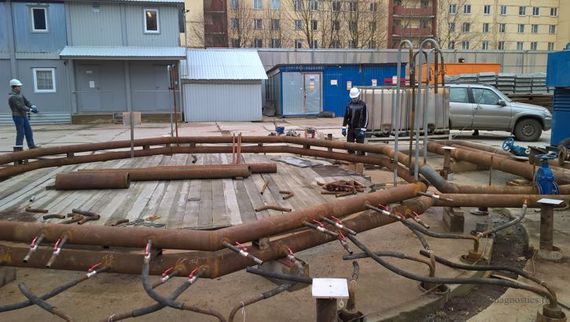
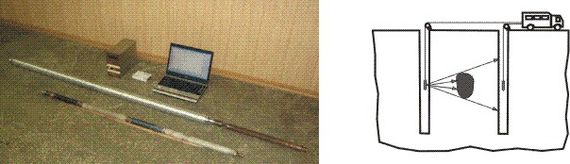
The sounding methodology includes excitement and receipt of an elastic wave impulse in holes (embedded tubes) and assessment of the crosshole environment, as a rule, based on parameters of the direct longitudinal wave going through it. The monitoring system is selected on the basis of tasks. A survey layout (plan view) is defined by the client by positioning monitoring tubes or boring holes. Depth survey scheme: simultaneous with moving borehole tools parallel to the ground surface (Fig. 1).
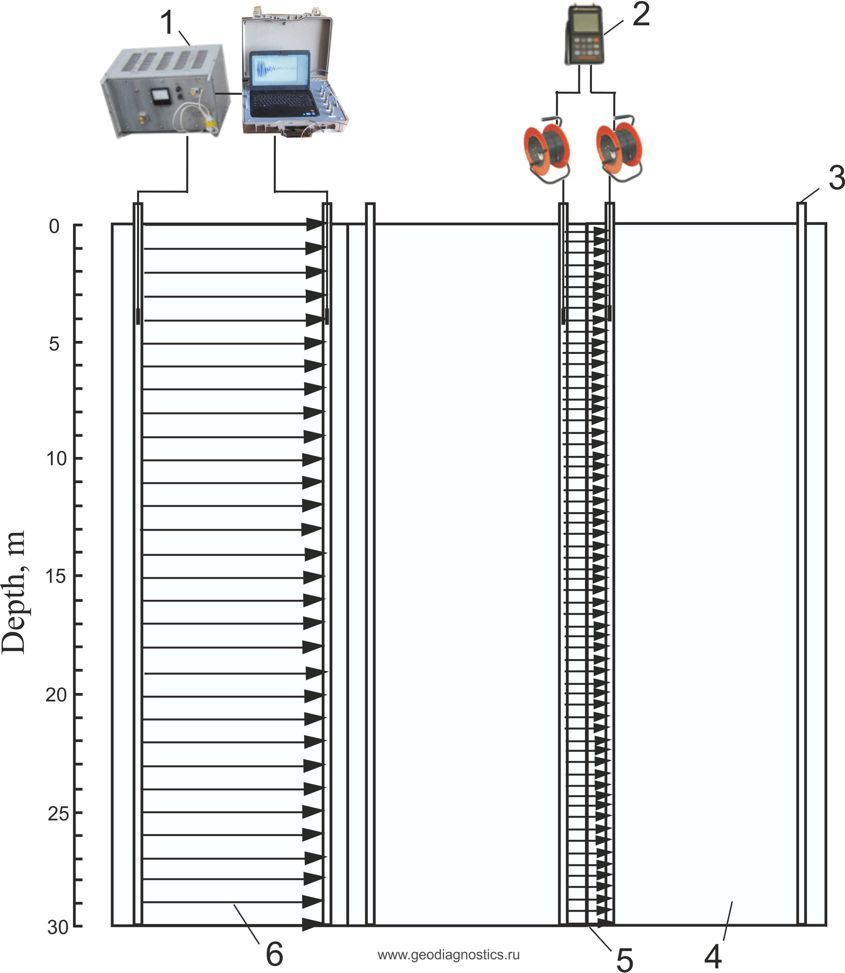
The depth survey interval is 0–100 m. The borehole tools step for descend movement is 0.5–1 m. Diagnostic parameters showing the condition of materials are the speed of the elastic wave (arrival time), the acoustic pressure range and the elastic wave pulse spectrum. The speed of the longitudinal elastic wave is the key diagnostic parameter. An additional advantage of the crosshole testing method is the possibility to implement crosshole tomography, due to the higher number of differently directed rays passing through the crosshole area.
3. Geophysical equipment
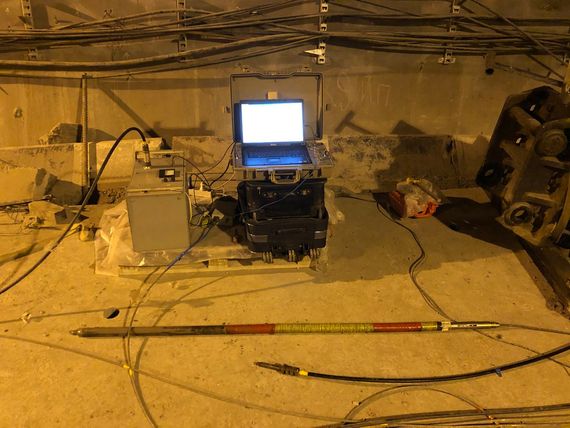
The studies used the pulsed acoustic crosshole sounding apparatus APZ-1 (developer Geodiagnostika, Russia) and the ultrasonic device Pulsar 2.2 DBS (developer Interpribor LLC, Russia). The operation principle of the hardware system is acoustic or ultrasonic wave sending, receiving the impulse upon passing through the area (concrete, soil, soil-cement, etc.), registration of the impulse on a PC hard drive, measuring impulse parameters by the operator, processing the observation results, and assessment of the state of the propagation area according to impulse parameters.
The crosshole sounding apparatus APZ-1 (Fig. 2) is designed for measuring propagation time, amplitude and impulse frequency of elastic waves in formations between the source and receiver, to determine the elasticity characteristics of the area.
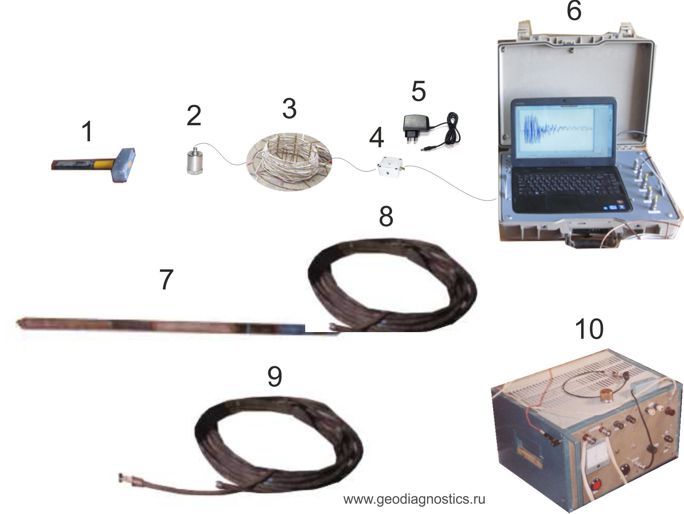
Apparatus APZ-1 consists of a sender and a software measurement system with the set of elastic wave receivers for surface and borehole measurements. Excitation of the elastic wave is carried out by mechanical or electrohydraulic shock. Excitation of the elastic wave by mechanical shock is performed by a shock hammer. For excitation of the elastic wave impulse by electrohydraulic shock, the sender enables the current impulse generator, cable and electric spark source. The metering system consists of receivers of elastic waves (borehole receiver or vibration transducer), cables and a PC-based set of hardware and software tools. Borehole devices operate together with a logging hoist equipped with KG-3 cable, or directly from the cables at shallow depth.
The hardware and software tools are designed for registration, processing and analysis of measured data. The software consists of the Windows operating system, command mode software and the WinPOS digital signal processing program. There can be additional software programs for digital processing of these measurements, including tomographic imaging of the cross-hole space, such as the TOMOGRAPHIYA software interface (developed by Geodiagnostika LLC), and the DOGSTOMO and TOMOSEIS programs.
When carrying out ultrasonic sounding of concrete, as a rule, the impulse repetition rate ranges between 1–50 Hz, the carrier frequency is 20000–100000 Hz, the minimal size of detectable defects is 0.1–0.2 m, and the acoustic pressure at the elastic wave impulse front is not big (in Pa). The ultrasonic method has a high resolution but is characterized by a relatively short length of up to 2–3 m; it also has limitations for use in highly absorbing mediums. A rational gauge length is 0.2–2 m.
As a rule, during crosshole acoustic testing of concrete the impulse repetition rate ranges between 0.1–0.3 Hz and the carrier frequency between 1–20000 Hz and higher, acoustic pressure at the elastic wave impulse front is high (up to MPa), rational gauge lengths are 0.7–10 m, and the minimal size of detectable defects is 0.5 m. The crosshole testing method has sufficient resolution, is characterized by a longer length of up to 50 m, and due to the high elastic wave energy it can be used in highly absorbing mediums (sounding through boundaries between mediums). The distance of sounding in concrete for apparatus APZ-1 is not less than 50 m, and for the device Pulsar 2.2 DBS up to 2–3 m.
4. Research results
4.1. Check and monitoring of fences in the underground space
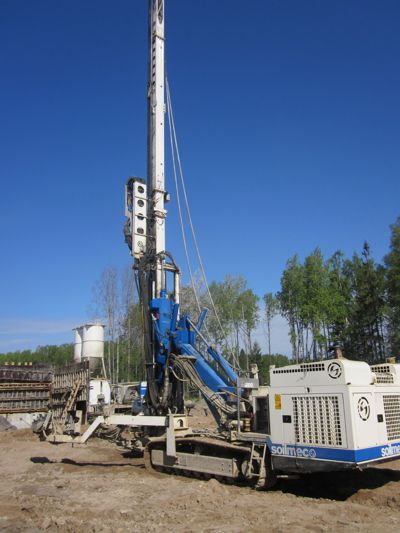
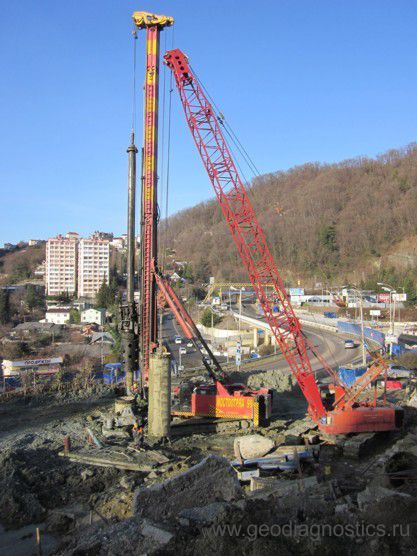
Investigations were carried out on hundreds of concrete slurry walls, jet grouting and frozen soil fences, grout curtains and piles in the construction of mine shafts (Volkovskaya, Mezhdunarodnaya, Bukharestskaya and others), sewer tunnels (the tunnel of the northern part of St Petersburg, the tunnel in the area of Ploshchad Muzhestva and others), the Ring Road, the Western High-Speed Diameter, the building of the Second Stage of the Mariinsky Theatre and others.
For the main types of fences and piles, tables of diagnostic characteristics are made. Tables of diagnostic characteristics allow the condition of the object of research (continuity, heterogeneity, the presence of defects) to be defined on the basis of a combination of diagnostic parameters (elastic wave velocity, the acoustic spectrum, the attenuation coefficient). The main diagnostic parameter is the speed of the longitudinal elastic wave.
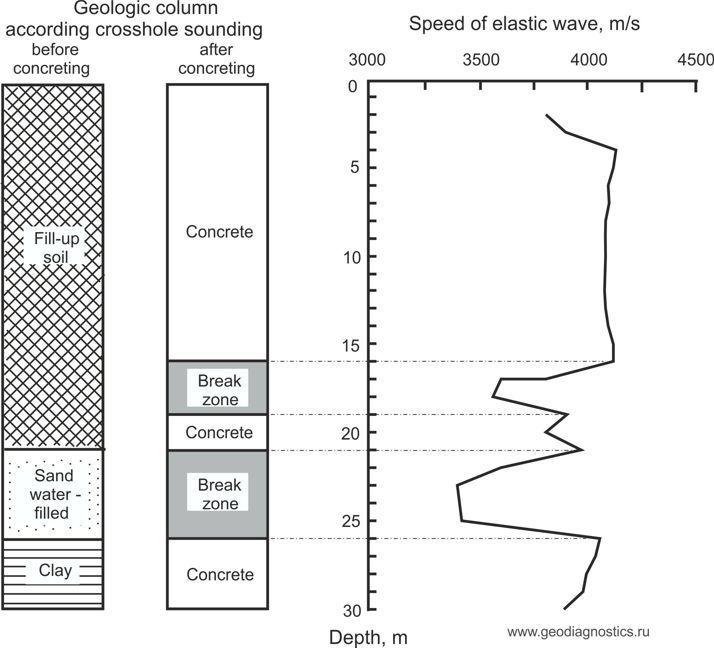
Graphics on the speed of elastic wave in the concrete slurry wall against depth, at the site of construction of the smoke extraction mine DU 2 of the Complex to protect St Petersburg from floods, are to be seen in Fig. 3. Reducing the speed of elastic wave in concrete occurs in areas of divergence of neighbouring concrete piles, in the intervals of occurrence of the fill-up soil and water-filled sand. Discontinuity zones in the concrete slurry wall caused the inflow of water into the mine in the process of excavation.
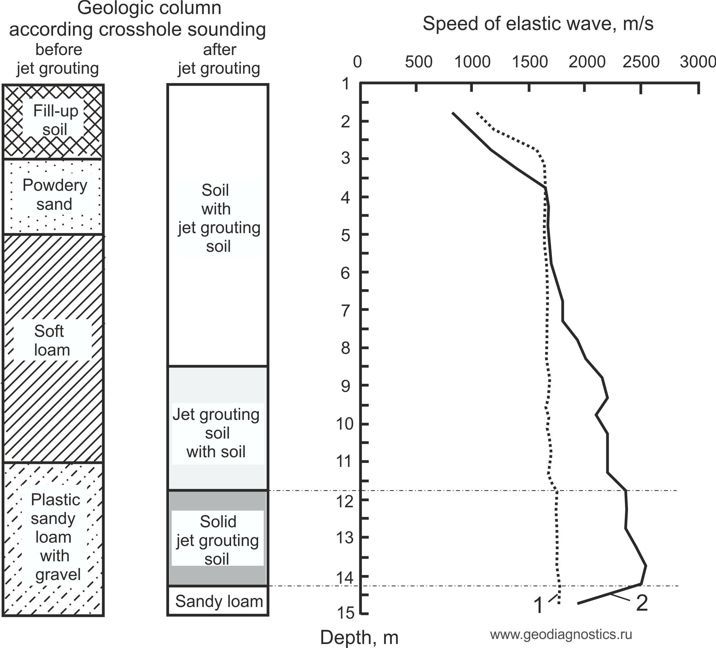
Graphics on the speed of elastic wave in the jet grouting massif against depth, at the site of construction of the building of the second stage of the State Academic Mariinsky Theatre, are to be seen in Fig. 4. The geological section on the complex seismic acoustic indication was divided by depth into the following intervals: 0–8.5 m — modified soil with jet grouting soil; 8.5–11.75 m — jet grouting soil with the inclusion of soil; 11.75–14.25 m — monolithic jet grouting soil; below 14.25 m — sandy loam. The maximum speed of elastic waves was fixed in the interval 11.75–14.25 m, where there was deposition of the monolithic jet-grouting plate.
Graphics on the speed of elastic wave in the fence from frozen soil against depth, at the site of construction of the reception mine for the inverted siphon (underground pipeline) to Kronstadt (St Petersburg), are to be seen in Fig. 5.
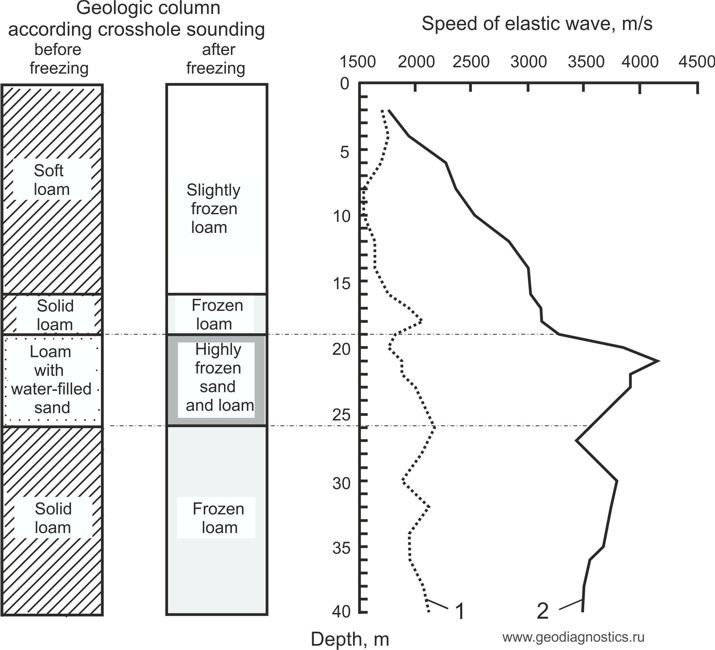
The aims of crosshole sounding of the fence from frozen soil were the allocation of intervals of water-filled soil before freezing, and determining the degree of soil freezing for safe excavation. Water-filled soils (sandy loam with interlayers of sand) were found at the depth 19–23 m (Fig. 5). The range of elastic wave velocity 3812–4182 m/s points to a sufficient degree of freezing of water-filled soils for safe excavation.
4.2. The calibration dependence “speed of elastic wave — compressive strength”
It is most widely known to produce the calibration dependence “speed — strength” for concrete. In Russia, the investigation of calibration dependencies for concrete is made on the basis of the document GOST 17624-2012 “Concrete. Ultrasonic method of strength determination”.
In my experience, for quality control of the jet grouting forming massif, the crosshole sounding method is more efficient than core sampling. In St Petersburg, on large construction sites, there were conflicts in the assessment of the quality of jet grouting work performed. The reason for the conflicts was the use of the traditional method of rotary core drilling, followed by laboratory testing of jet-grouting soil cores at uniaxial compression. It does not take into account two factors. First, jet-grouting soil is much less solid and homogeneous compared with concrete. Second, the core sample in a single-core barrel is not protected from contact with the rotating and vibrating core tube, and is subjected to abrasion and crushing. Therefore the jet-grouting soil strength determined by the core is much smaller than that set in the project documentation.
During the period 2003–2007, at the construction site of the Ring Road around St Petersburg, hundreds of jet-grouting core samples were tested for compression after the measurement of the speed of elastic wave. We obtained a few calibration dependencies, with areas of application depending on the type of replaced natural soil. The calibration dependence “speed of elastic wave v — compressive strength R” for jet grouting soil based on loam and sandy loam (shown in Fig. 6) was approximated by a function of the form:
R = 0.1142e0.0017v (1)
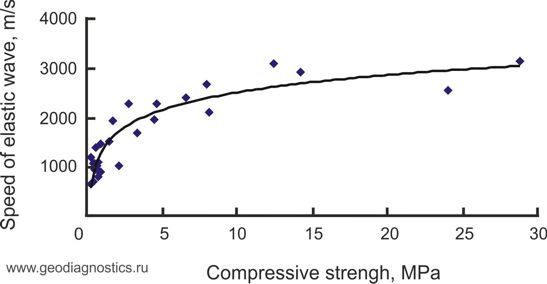
Dependence (1) has been tested on dozens of construction sites in St Petersburg. The calibration dependence “speed of elastic wave — compressive strength” allows the strength of the material of fences to be controlled in situ by crosshole sounding, and coring to be abandoned.
Conclusion
As a result of the research, the following conclusions were made.
- The geophysical method of crosshole sounding, between holes drilled in the artificial soil or between embedded tubes installed in the reinforcement before concreting, provides check and monitoring of the condition of protection fences and grout curtains during the construction of underground mines and sewers.
- Characteristics of the crosshole sounding apparatus, including operating frequency range and sound pressure on the front of the elastic wave pulse, are selected depending on the elastic properties of the fencing material.
- Determination of the strength of jet grouting soil and concrete by crosshole sounding in situ eliminates the need for core samples from underground fences.