

APZ-1 — impulsive acoustic and ultrasonic crosshole raying and probing
Computer-controlled hardware system for continuity control of underground fences, pit-shaft guards, road foundations and bridge bearings
Acoustic, elastic, deformation and strength properties and the fracture porosity of the materials of foundations of buildings and structures (soil, concrete, soil-cement) are connected together, which allows acoustic methods to be used when controlling the quality of constructions, exploration and geotechnical works.
Technical means and technologies of impulse crosswell acoustic raying and probing of rock masses were developed by the All-Russian Research and Development Institute of Exploration Methods at the end of the 1960s. MAP-1 (1974) and API-1 (1981) equipment were in serial production. After the reorganization of the Institute, work on the development of technical means and technologies of acoustic raying and probing was passed to Geodiagnostics Ltd.
Hardware system
Currently there is a developed computer-controlled hardware system of impulsive acoustic raying and probing, APZ-1, which includes an emitter and a measuring system. The emitter system consists of a current impulse generator, high-voltage cable and electric spark source. The measuring system consists of a borehole receiver or vibration transducer, an amplifier and a complex of PC-based software and hardware. Borehole equipment is used jointly with a logging truck hoist equipped with KG-3 type cable, in hydro-filled boreholes or blastholes with diameter 46 mm or more, depth to 150 m and distances between them to 100 m.
The APZ-1 hardware system is intended to measure transmission time, amplitude and frequency of the elastic wave impulse in the rock mass between emitter and receiver, with the purpose of determining the elastic properties of the environment. The APZ-1 hardware system is calibrated by the D. I. Mendeleev Research and Development Institute of Metrology (certificate of instrument calibration No. 2520-944 dated 11.04.2006). Main APZ-1 measurement percentage errors: time ±5%; vibratory acceleration ±8%; oscillation frequency ±2%.
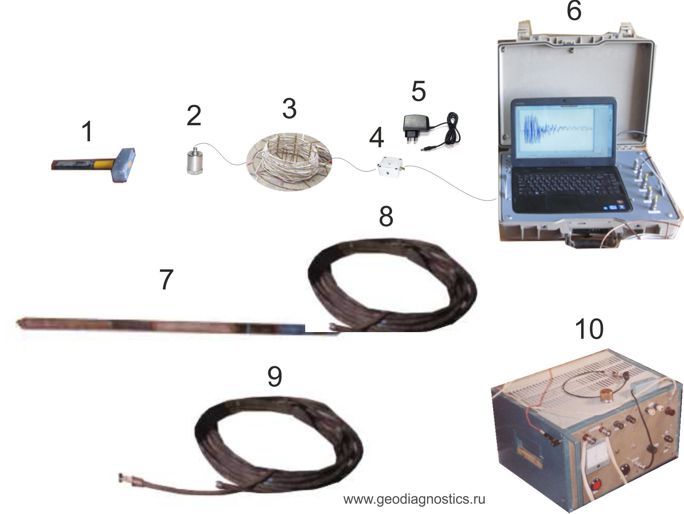
The hardware system provides
- monitoring of soil conditions and reconstructions of surface building foundations before and after influence on them by different reinforcement ways; monitoring of the quality of soil bondability and cementation in mine roadway construction (holes, tunnels, inclined tunnels) and road foundations;
- determination of the existence of pore spaces and of the properties of the concrete slab environment; monitoring of the condition of tunnel lining and road surface; control of bored and precast piles and concrete bridge bearings;
- geological segmentation, detection and edging of blind ore bodies, quartz reefs, fracture zones, karsts, taliks, buried ice, and the lower bound of incoherent mass and residual soil.
Range and resolution
The sounding distance in incoherent soils (sand, sandy clay) is no less than 20 m; in rocky soils (granites) it reaches 150 m. Penetration depth in rocky soils and concrete is to 40 m. Resolution ability in soil acoustic raying is ±0.5 m, and in rock mass and concrete raying ±0.05 m.